Visionary CCP Framework QA Committee Principles
The College of Pharmacists of Manitoba (CPhM) is revising its Continuing Competency Program (CCP) to ensure it remains meaningful, evidence-informed, and supportive of quality pharmacy practice in Manitoba. Consultant Dr. Nancy Winslade, together with the Quality Assurance (QA) Committee, is leading this work to develop a program that strengthens day-to-day practice while minimizing administrative burden. This work is guided by evidence, ongoing feedback from pharmacy professionals, and best practices from regulatory bodies across Canada and internationally.
The Visionary CCP Framework currently applies to registered pharmacists. At present, CPhM does not fully regulate pharmacy technicians. Once CPhM transitions under The Regulated Health Professions Act (RHPA), CPhM will have a similar responsibility to assure the competency of pharmacy technicians, as it does for registered pharmacists.
The following graphics outline the Visionary CCP Framework and the QA Committee Guiding Principles that are shaping the development of a revised, evidence-informed approach to continuing competence.
Visionary CCP Framework
CPhM recently approved the following Visionary CCP Framework to serve as a strategic guide for CPhM’s QA Committee to pilot test, evaluate, and finalize a revised CCP and to design a comprehensive implementation plan. The visionary CCP framework is comprised of three components that work together to form a modernized program: Maintenance of Competency (MOC), Continuous Quality Improvement (CQI), and Continuing Education (CE).
Grounded in an apex principle of clarity, the framework establishes explicit, visionary statements of future CCP requirements of pharmacists and outlines the underlying evidence supporting this visionary model. Click on the specific components to view both the specific requirements for each component, as well as a brief outline of the rationale for the requirements.
It is emphasized that several of the changes described in the Visionary CCP Framework cannot be implemented until CPhM has transitioned to The Regulated Health Professions Act (RHPA), while others require development and pilot testing. However, the framework provides CPhM and the QA Committee with an approved visionary CCP for their continuing work.
As developmental work continues, additional background information is available to pharmacy professionals in the Registrant Portal.
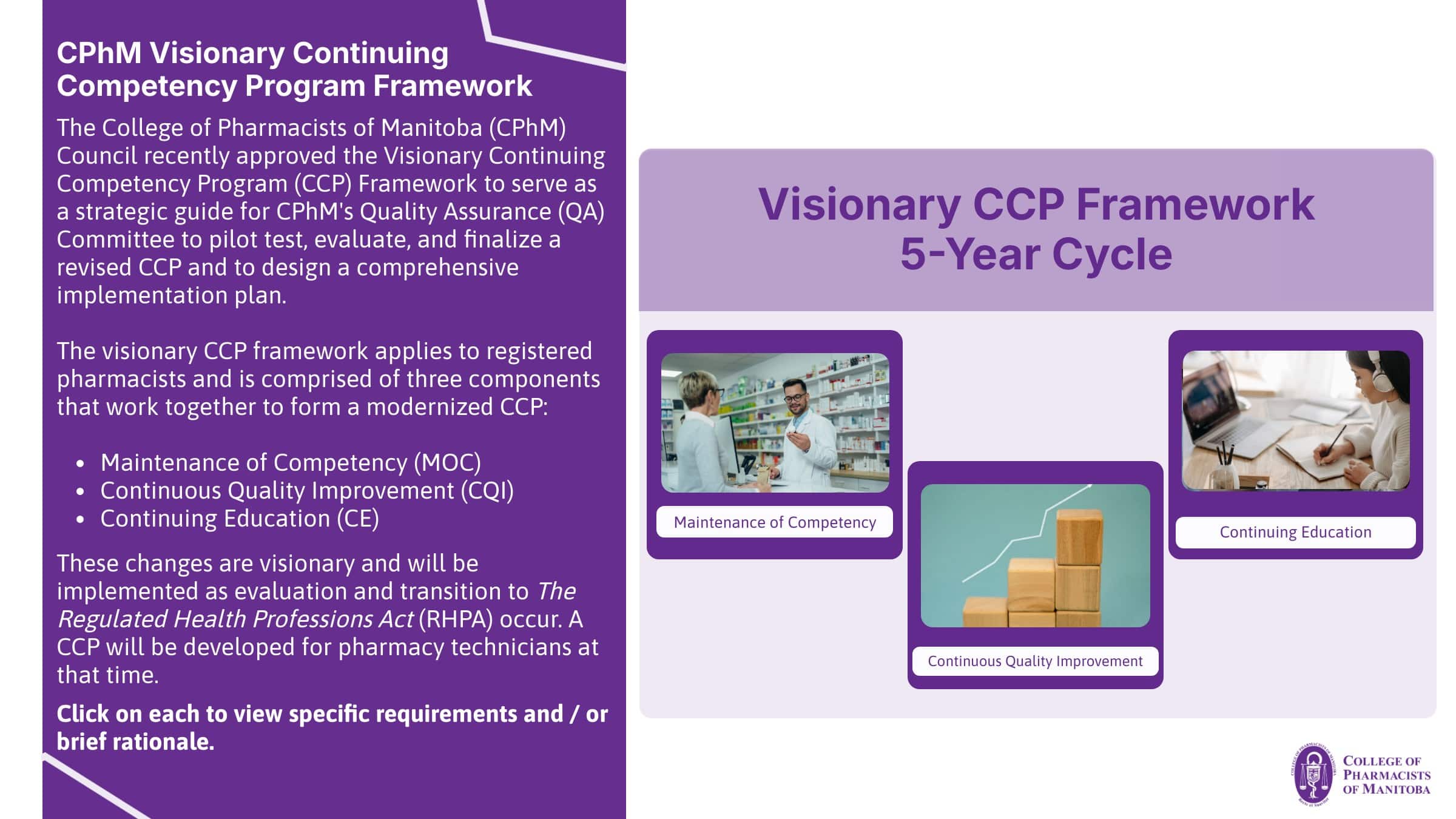
For more information about the framework, including the frameworks details and rationale, please click on the picture or here: https://view.genially.com/6a79de8656ccc7ab75965cfc
*To read the Visionary CCP Framework, click on a section
Quality Assurance Committee Principles
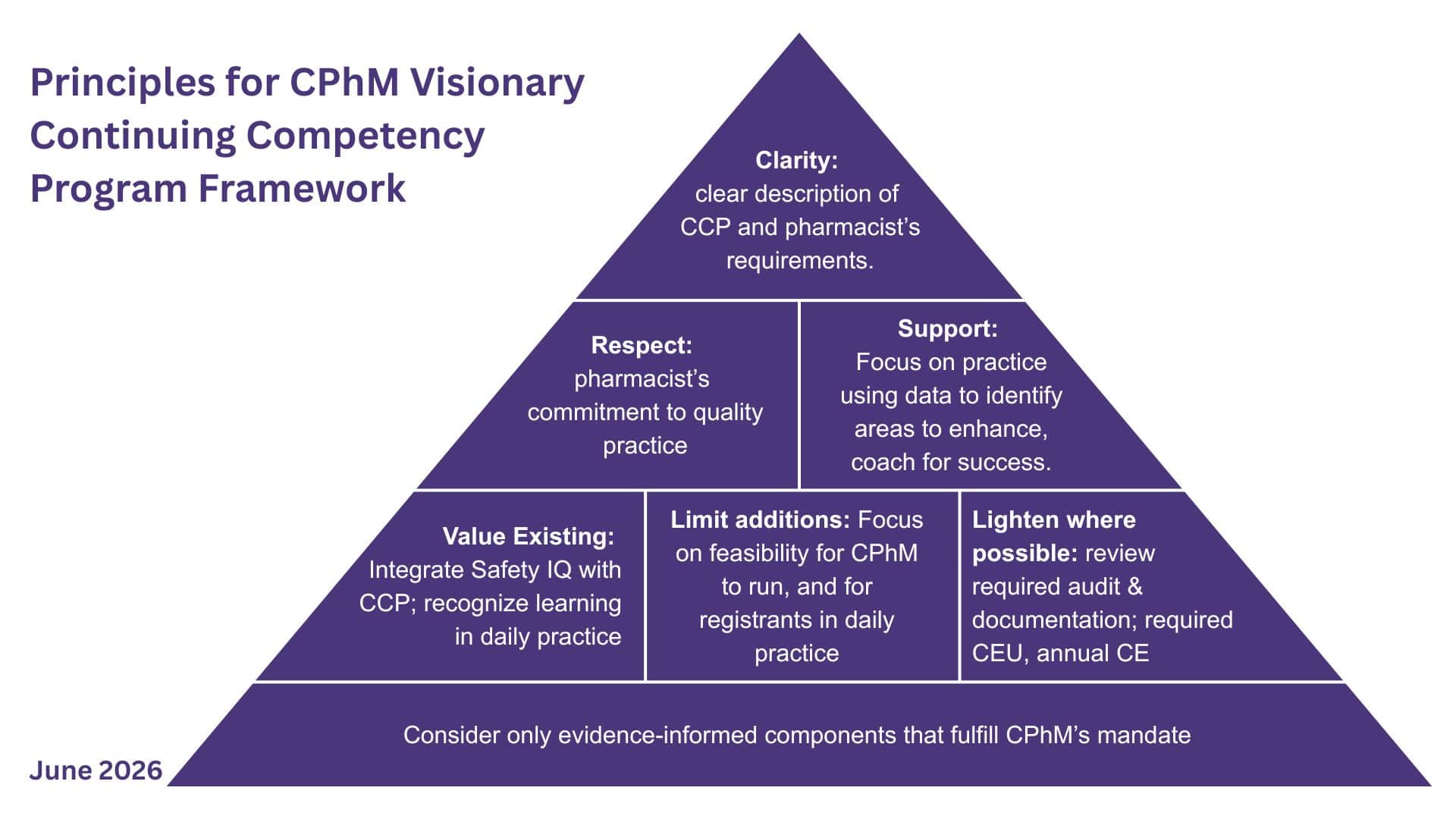
The QA Committee established a series of principles that were followed in designing the Visionary CCP Framework as illustrated in the figure below. These principles emphasize a transition toward evidence-informed best practices; remove existing, less robust requirements, and: integrate existing CPhM requirements —such as the Safety IQ program—to actively reduce pharmacist workload burdens. This aims to ensure that transition toward an evidence-informed CCP remains both scientifically sound and practically achievable for Manitoba pharmacists.
Principles:
These are the principles upon which the revised CCP is based:
- Foundational Principle: Historically, CCPs have included a range of programs such as continuing education, on-site assessments and OSCE-type assessments. Best practices continued to evolve, however, and CPhM’s revised CCP includes only evidence-informed, best practices that fulfill CPhM’s regulatory requirements.
- Core principles take into consider pharmacists’ engagement and workload:
- Value existing pharmacists’ activities: integrate CPhM requirements, such as Safety IQ, into the revised CCP and recognize learning in daily practice;
- Limit additional requirements: ensure additions are feasible for CPhM to administer and for pharmacists to complete in daily practice;
- Lighten where possible: review current CCP requirements and eliminate or lighten where possible.
- Building principles emphasize that CPhM and pharmacists have a common goal of quality pharmacy practice:
- Respect pharmacists’ commitment to quality practice;
- Support pharmacists’ efforts to continuously enhance their practice by facilitating use of practice data and coaching for success.
- Apex principle is clarity: clear, direct statements of what pharmacists must do to fulfill CCP requirements.
- Core principles take into consider pharmacists’ engagement and workload: