
Quick Facts FAQ Publications Feedback
The College of Pharmacists of Manitoba (CPhM) is revising its Continuing Competency Program (CCP) to ensure it remains meaningful, evidence-informed, and supportive of quality pharmacy practice in Manitoba. Consultant Dr. Nancy Winslade, together with the Quality Assurance Committee, is leading this work to develop a program that strengthens day-to-day practice while minimizing administrative burden. This work is guided by evidence, ongoing feedback from pharmacy professionals, and best practices from regulatory bodies across Canada and internationally.
Quick Facts:
- Project Start: Early 2025
- Anticipated Completion: Approval early 2027 with phased implementation
- Lead Consultant: Dr. Nancy Winslade, BScPhm, PharmD, MHPE, PhD
- Purpose: To create an evidence-informed CCP that assures maintenance of competence and supports ongoing enhancements in pharmacy practice
- Principles:
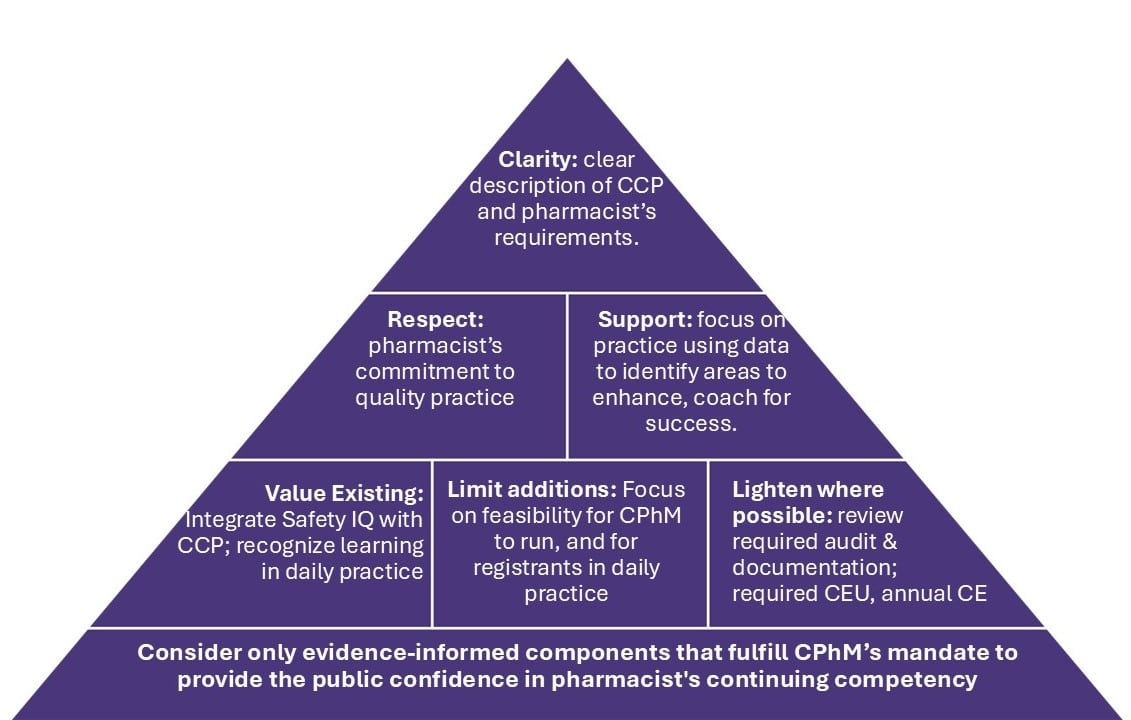
- These are the principles upon which the revised CCP is based:
- Foundational Principle: Historically, CCPs have included a range of programs such as continuing education, on-site assessments and OSCE-type assessments. Best practices continue to evolve, and CPhM’s revised CCP will include only evidence-informed, best practices that fulfill CPhM’s regulatory requirements.
- Core principles take into consider pharmacists’ engagement and workload:
- Value existing pharmacists’ activities: integrate CPhM requirements, such as Safety IQ, into the revised CCP and recognize learning in daily practice;
- Limit additional requirements: ensure additions are feasible for CPhM to administer and for pharmacists to complete in daily practice;
- Lighten where possible: review current CCP requirements and eliminate or lighten where possible.
- Building principles emphasize that CPhM and pharmacists have a common goal of quality pharmacy practice:
- Respect pharmacists’ commitment to quality practice;
- Support pharmacists’ efforts to continuously enhance their practice by facilitating use of practice data and coaching for success.
- Apex principle is clarity: clear, direct statements of what pharmacists must do to fulfill CCP requirements.
- These are the principles upon which the revised CCP is based:
FAQ for Pharmacy Professionals
This FAQ provides detailed information about the Continuing Competency Program Project (CCP).
Why is CPhM revising its Continuing Competency Program?
Traditional Continuing Education (CE) programs have limited impact on the quality of daily practice. Health care professionals have difficulty accurately self-assessing their practice strengths and weaknesses, leading to selection of CE based on factors such as availability, cost or general interest rather than on practice need. Alternate programs are necessary to both assure the public that pharmacists maintain their competence to practice and to support meaningful improvement that reflects today’s practice realities.
How will the revised CCP support my everyday practice?
The QA Committee has focused on the ‘dual reality’ that requires CPhM to carefully consider the challenges of pharmacists’ daily practice when developing a program that fulfills CPhM’s regulatory requirements. Focus is being placed on recognizing pharmacists’ daily, ongoing efforts to continuously enhance their practice through, for example, learning for individual patients, teaching and preceptorship. CPhM is also focused on supporting pharmacists making use of data from their own practices to guide learning and improvement.
What does competency mean?
The definition of competency CPhM is using is:
- The habitual and judicious use of communications, knowledge, technical skills, clinical reasoning, emotions, values and reflection in daily practice for the benefit of the individual and community being served. (i)
-
- i. Epstein RM, Hundert EM. Defining and Assessing Professional Competence. JAMA. 2002;287(2):226.
What evidence is guiding this work?
CPhM is reviewing models used by regulators for pharmacy and the broader health professions across Canada and internationally. These programs have different names such as CCP, Quality Assurance (QA), Practice Improvement (PI), Continuing Professional Development (CPD), and Continuing Quality Improvement (CQI). Many of these programs are undergoing similar review, and CPhM is collaborating to both learn from the PRA ‘s ongoing experience and to share literature that is defining current best practices.
What are the key criteria for the new program?
The CCP must consider the five main criteria for quality programs as follows (ii):
- Validity – Does the program measure and support the development of important aspects of pharmacist’s quality of practice?
- Reliability – Is the program fair and consistent across different days, sites, pharmacists, and situations?
- Feasibility – Are the necessary resources available to CPhM to implement the program within reasonable timeframes? Is it realistic for registrants to complete the program’s requirements given practice expectations?
- Acceptability – From CPhM’s perspective, is the program feasible and does it meet regulatory requirements? For registrants, acceptability also includes whether the program feels meaningful and supports them in their efforts to improve their practice.
- Impact – Does the program lead to desired changes in practice? Does it avoid unintended negative consequences, especially given the high workload pharmacy professionals face?
-
- ii. Van der Vleuten CPM. The Assessment of Professional Competence: Developments, Research and Practical Considerations. Advances in Health Sciences Education. 1996;(1):41-67.
Will there be opportunities for registrants to provide feedback?
Registrant feedback is important for the QA Committee to clearly understand how the proposed revisions to the CCP would affect pharmacist’s daily practice and to be aware of pharmacist’s concerns and potential anxieties surrounding new CCP requirements. This understanding enables the QA Committee to address these issues directly with the goal of supporting pharmacists and encouraging their engagement with the new CCP. Pharmacy professionals will have multiple opportunities to participate in focus groups, have their questions answered, and provide their perspectives on the proposed revisions to the CCP. Please keep an eye on future Friday Fives and Newsletters for feedback opportunities.
What is the purpose of the Continuing Competency Program? Won’t this just take up more of my time?
- The Continuing Competency Program is designed to support pharmacy professionals in their daily practice while ensuring CPhM meets its regulatory responsibilities. CPhM and the Quality Assurance Committee recognize constraints in pharmacy professionals’ work and daily lives and want to ensure the program maximizes value and minimizes administrative burden.
When will the work on the Continuing Competency Program be complete?
Timelines will be finalized as evidence is reviewed. Updates will be shared through CPhM’s Friday Fives and Newsletters.
Publications Archive
- Friday Five (May 13, 2025) – https://cphm.ca/friday-five/friday-five-may-23-2025/#ContinuingCompetencyMatters
- Friday Five (June 6, 2025) – https://cphm.ca/friday-five/friday-five-june-6-2025/#ContinuingCompetencyMatters
- Friday Five (June 20, 2025) – https://cphm.ca/friday-five/friday-five-june-20-2025/#ContinuingCompetencyMatters
- Friday Five (July 4, 2025) – https://cphm.ca/friday-five/friday-five-july-4-2025/#ContinuingCompetencyMatters
- Friday Five (July 18, 2025) – https://cphm.ca/friday-five/friday-five-july-18-2025/#ContinuingCompetencyMatters
- Friday Five (August 1, 2025) – https://cphm.ca/friday-five/friday-five-august-1-2025/#ContinuingCompetencyMatters
- Friday Five (August 29, 2025) – https://cphm.ca/friday-five/friday-five-august-29-2025/#ContinuingCompetencyMatters
- Friday Five (September 12, 2025) – https://cphm.ca/friday-five/friday-five-september-12-2025/#ContinuingCompetencyMatters
- Friday Five (September 26, 2025) – https://cphm.ca/friday-five/friday-five-september-26-2025/#ContinuingCompetencyMatters
- Friday Five (October 10, 2025) – https://cphm.ca/friday-five/friday-five-october-10-2025/#ContinuingCompetencyMatters
- Friday Five (October 24, 2025) – https://cphm.ca/friday-five/friday-five-october-24-2025/#ContinuingCompetencyMatters
- Friday Five (November 21, 2025) – https://cphm.ca/friday-five/friday-five-november-21-2025/#ContinuingCompetencyMatters
- Friday Five (December 5, 2024) – https://cphm.ca/friday-five/friday-five-december-5-2025/#ContinuingCompetencyMatters
- Friday Five (January 30, 2026) – https://cphm.ca/friday-five/friday-five-january-30-2026/#CCM
- Friday Five (February 13, 2026) – https://cphm.ca/friday-five/friday-five-february-13-2026/#CCM
- Friday Five (February 27, 2026) – https://cphm.ca/friday-five/friday-five-february-27-2026/#CCM
- Friday Five (April 24, 2026) – https://cphm.ca/friday-five/friday-five-april-24-2026/#CCM
- Friday Five (May 8, 2026) – https://cphm.ca/friday-five/friday-five-may-8-2026/#CCM
- Friday Five (May 22, 2026) – https://cphm.ca/friday-five/friday-five-may-22-2026/#CCM
- Friday Five (June 5, 2026) – https://cphm.ca/friday-five/friday-five-june-5-2026/#CCM
- Friday Five (July 19, 2026) – https://cphm.ca/friday-five/friday-five-june-19-2026/#CCM
Feedback